
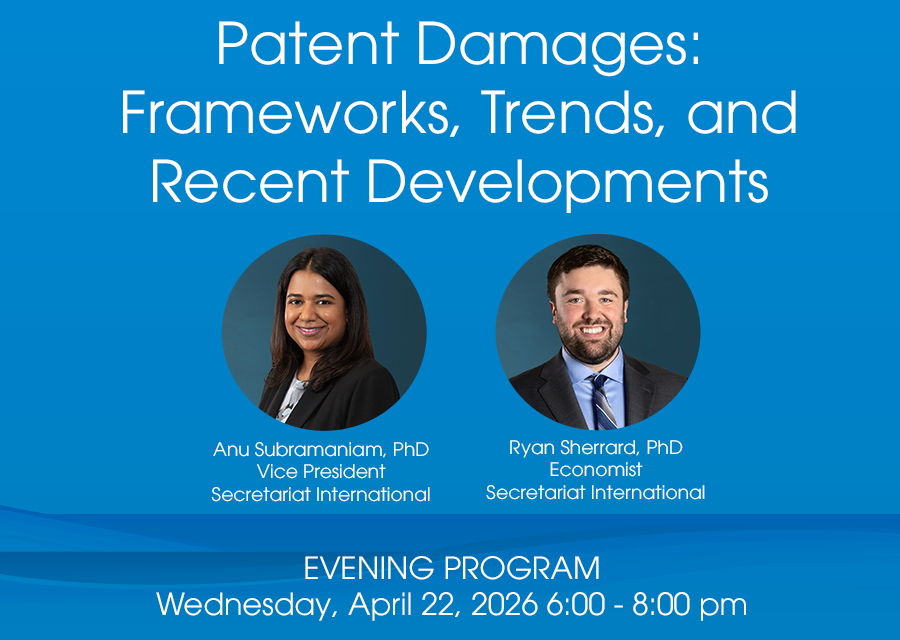
This presentation provides an economist’s perspective on the framework used to assess damages in patent litigation, including how experts analyze reasonable royalties and lost profits. It discusses the role of apportionment in damages analyses and the types of economic evidence courts rely on when evaluating expert testimony. The session also reviews recent developments affecting damages modeling and the practical implications for litigants and their experts.
- Presenters: Anu Subramaniam, PhD, Vice President, Secretariat International and Ryan Sherrard, PhD, Economist, Secretariat International
- Date: Wednesday, April 22, 2026
- Time: 6:00 – 7:00 p.m. networking and heavy appetizers, 7:00 – 8:00 p.m. presentation
- Location: Knobbe Martens, 3579 Valley Centre Drive, First Floor Conference Room, San Diego, CA 92130
This presentation will qualify for 1 hour of CLE credit.
If you are not sure if you are a member, please email
board@sdipla.org
Speaker Bios
Anushree Subramaniam has expertise in health economics, behavioral economics, applied microeconomics, economics of innovation, industrial organization, and applied econometrics.
Dr. Subramaniam provides economic expertise in high-stakes litigation matters relating to biotechnology and pharmaceuticals, medical devices and diagnostics, personalized medicine, consumer electronics, and telecommunication technology. Dr. Subramaniam performs complex, data-driven analyses of reasonable royalties, lost profits, irreparable harm, injunctive relief, commercial success, and patent portfolio value.
Dr. Subramaniam is particularly well versed on economic issues pertaining to the life sciences industry and has taken the lead on matters relating to blockbuster drugs, biosimilar entry, and cutting-edge gene therapies. During her PhD studies, Dr. Subramaniam received the prestigious Mellon/ACLS Dissertation Completion Fellowship in recognition of her dissertation research relating to the value of healthcare innovation for rare diseases.
Ryan Sherrard has expertise in labor economics, applied econometrics, policy evaluation, and the economics of crime.
Much of Dr. Sherrard’s research has focused on using applied econometrics to analyze the relationships between the criminal justice system, public policy, and the labor market. In one paper, currently under revision at the Journal of Public Economics, Dr. Sherrard evaluated the impact of “Ban the Box” policies on criminal recidivism rates. He used a staggered-adoption difference-in-difference framework to evaluate the effect of restricting employer access to applicants’ criminal history on recidivism for ex-offenders by race.
His work contributed to our understanding of the labor market for persons with a record. In other work, Dr. Sherrard examined the determinants of sentencing behavior in local criminal justice officials. Specifically, he has written papers estimating the sentencing impact of electoral pressure and local television news coverage on prosecutors and judges. He has also served as a referee for Labour Economics.